Advantages of water source heat pump system
(1) Urban water source heat pump air conditioning technology can achieve winter heating, summer air conditioning, year-round domestic hot water supply (very cheap hot water supply solution), and partial free domestic hot water supply in summer. Urban water source heat pump air conditioning is a high-tech technology with energy saving, environmental protection and economic benefits, which is in line with the sustainable development strategy of economy and society.
(2) Urban water source heat pump unit uses water as cold and heat source. In winter, it collects low-grade heat energy from water. With the help of heat pump system, it consumes part of the electric energy (1 part) and supplies the obtained energy (more than 4 parts) to indoor heating; in summer, it extracts the indoor heat and releases it into water to achieve the purpose of summer air conditioning. It has the following characteristics:
1) Significant environmental benefits
Water source heat pump is a heating and air conditioning system that uses water as cold and heat source for energy conversion. When heating, it eliminates the need for coal, gas, oil and other boiler room systems. There is no combustion process, which avoids exhaust pollution; when cooling, it eliminates the need for cooling towers, which avoids the noise and mold pollution of cooling towers. No waste residue, wastewater, exhaust gas, or smoke is generated, resulting in significant environmental benefits.
2) High Efficiency and Energy Saving
In winter, the water temperature is higher than the ambient air temperature, which increases the evaporation temperature of the heat pump cycle and improves energy efficiency. In summer, the water temperature is lower than the ambient air temperature, which reduces the condensation temperature during cooling, resulting in better cooling than air-cooled and cooling tower systems and increased unit efficiency.
3) Stable and Reliable Operation
Water temperature is relatively stable year-round, with fluctuations far less than those of air. It is an excellent heat source for heat pumps and a cooling source for air conditioning. The relatively constant water temperature makes heat pump operation more reliable and stable, ensuring the system's efficiency and economy. It eliminates the difficulties of winter defrosting, as is common with air-source heat pumps.
4) Multi-Purpose Unit, Wide Application Range
This heat pump system can provide heating and domestic hot water (free in summer). Its multi-purpose function allows a single system to replace two existing boiler and air conditioning systems. 2. Operation principle of water heat pump
(1) Operation mechanism
The main technical principle is the operation mechanism of the heat pump, which is to transfer the heat or cold in the water to the building. It can be divided into three energy transmission and transfer processes:
1) Water transfers the heat and cold to the refrigerant through the heat exchanger or evaporator. Or direct transfer, that is, water directly enters the evaporator or condenser; or indirect transfer, that is, water first transfers the heat and cold to clean water, and then the clean water enters the evaporator or condenser.
2) The refrigerant transfers and converts heat between the evaporator and the condenser. The refrigerant absorbs external heat in the evaporator, evaporates, is sucked in and compressed by the compressor, and becomes a high-temperature, high-pressure gas. After the gas enters the condenser, it transfers heat out through the condenser.
3) The heat discharged from the condenser will provide a heat source for the hotel, etc.
In the process of energy transmission and transfer, the energy input-output ratio of the heat pump unit can reach up to 4.4, that is, when the motor input power is 1kcal, the energy obtained from the terminal system is 4.4kcal. During the entire process, a small amount of electricity is consumed, and the energy of water is greatly utilized, thereby achieving the purpose of energy saving. The cooling process is the reverse process of the heating process.
(2) Process flow
To realize this energy transmission and transfer process, several cold and hot medium circulation systems are required, including:
1) Water intake and drainage system, which is a closed system.
2) Terminal circulation system, which is a closed system.
(3) Technical key points
The problem after the project transformation is the heat exchange technology with the water source, that is, the various problems that may be caused by poor water quality in the heat exchange process have not been solved before, mainly including blockage, pollution and corrosion.
(4) System design issues
1) Classification and selection of system forms
Water source heat pump systems can be divided into two categories: direct and indirect. If the water source water directly enters the evaporator or condenser of the heat pump unit for heat exchange, it is a direct system. If the water source water first exchanges heat with the intermediate water and the intermediate water enters the unit, it is an indirect system. Direct systems have high requirements for source water quality, or in other words, for the evaporator and condenser's ability to adapt to poor water quality. This water quality is generally limited to secondary effluent from urban water stations, river and lake water, seawater, groundwater, and some industrial wastewater. This type of source water contains only small amounts of suspended solids with a particle size of less than 1 mm and is relatively clean. The evaporator and condenser must be reliably resistant to blockage, contamination, and corrosion.
Indirect systems, on the other hand, use source water heat exchangers instead of evaporators and condensers to extract heat (or cool). Therefore, the requirements for source water quality are significantly reduced. Engineering practice has proven that even with extremely poor quality, untreated urban raw water, the entire system can safely and continuously extract heat and cool water over a long period of time by utilizing rotary backwashing to prevent blockage.
This project utilizes a direct system.
2) Heat Exchange Method
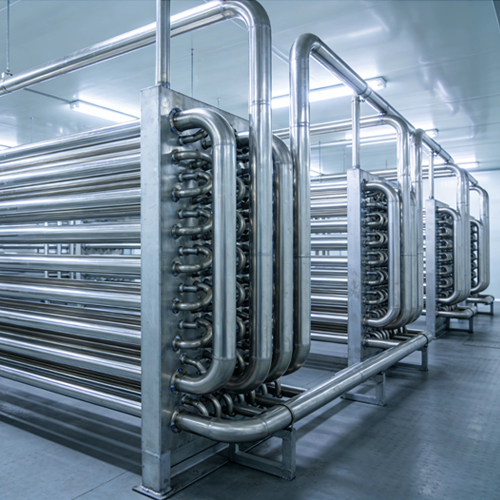
Possible heat exchange methods include compact heat exchanger, non-compact shell-and-tube heat exchange, air heating, and immersion. Using compact heat exchangers for heat exchange must address three issues: clogging, contamination, and corrosion. Considering these three issues, the shell-and-tube heat exchanger is the most suitable for non-clean water (the shell space cannot be cleaned) among all compact heat exchanger types. Other heat exchanger types, such as plate and spiral plates, face significant challenges in addressing these three issues. Therefore, the shell-and-tube heat exchanger is the optimal solution for this project.
3) Heat Exchange Operating Conditions
Heat exchange operating conditions refer to the temperature at each node in the system (the inlet and outlet of non-clean ground water, the inlet and outlet of intermediate water, the evaporator, the condenser, etc.) and the flow rate of each loop (the non-clean ground water loop and the intermediate water loop). These parameters must first ensure that the system can achieve its intended use. Under this premise, they directly determine the investment in equipment such as the unit, heat exchangers, and pumps, as well as the system's operating costs.
Higher evaporation temperatures and lower condensing temperatures result in higher energy efficiency. However, these are each limited by existing and demanding conditions. The condensing temperature is limited by the end-use requirements, which are typically fan coil units or floor heating. The evaporation temperature is limited by the source water temperature and water volume. While considering performance and operating efficiency, it's important to avoid using an excessively large heat exchange area and consider the initial investment in the heat exchange equipment. While considering using a large water volume to improve heat exchange performance, the pump's power consumption must also be considered.


 Home > Products